Austria part 1: passionate wine makers

P1060001

Neusiedlersee from the vineyards.

A little while ago I was lucky enough to have a fabulous trip around most of Austria’s wine regions. I was pretty excited about it as I had long wanted to get a real look at this resurgent wine producing country.

Personally I have always been drawn to the Austrian /  Central European culture and have always enjoyed the food and the beer and liked the look of this part of the world. So, I was looking forward to getting better acquainted with it as well as seeing the wine regions and meeting many of the important winemakers.

For reasons of economy I flew in through Bratislava, which is very close to Vienna and was for hundreds of years the Imperial Austrian city of Pressburg or Preßburg. I didn’t have time for a meal, unusually for me I didn’t have the inclination either as I knew my plans for later that evening in Vienna, so I grabbed a sandwich and a beer at the airport.

I was already somewhere interesting when something as a simple ham and cheese sandwich bore no relation to its counterparts at home. It came on black bread with smoky Black Forest ham, rich cream cheese, loads of pickles and was delicious. The beer too was far better than such a simple thing as a lager would normally be in my life, it had a rich hoppy character and a depth of flavour that would astonish most members of CAMRA.

Arriving in Vienna for the first time in 27 years I strolled around this grand city trying out some of the wonderful coffee houses and cafés for which the place is justly famous. It seemed as though almost every building housed a cake shop – do they really eat that much cake I wondered? Watching the Viennese at play over the course of the evening it seemed that they really did – and later I joined them myself.

Dinner that night was a sort of pilgrimage for me. All my life I have been excited by schnitzels – I know it sounds strange, it even looks odd to me now I have actually typed the words, which is akin to saying them out loud. Hell, it’s cheaper than therapy! I am always drawn to schnitzel on a menu though, even if there is finer fare to be had. I have this theory that schnitzel is the best dish in the world – no not a theory, a belief! So I went to the place where the schnitzel began.

The Wiener Schnitzel is a classic dish, but it seems that no one can actually find much of a history for it. I remember reading that General Joseph Radetzky von Radetz – he of the march / waltz fame – was supposed to have brought it back to Austria after campaigning in Lombardy and Milan. A Milanese Cutlet / Cotoletta alla Milanese is superficially similar and the Austrians were supposed to have refined it by bashing the meat out to tenderise it and make it very thin. Sadly it seems that this is a myth though and no one knows exactly where it came from or when.

Wiener Schnitzel at Figlmüller with a €2 piece for comparison.

Wiener Schnitzel at Figlmüller alongside a €2 to compare the sizes.

In Vienna there is a restaurant called Figlmüller that not only claims to have invented the schnitzel, but to have done so as recently as 1905. I find that extraordinary as 1905 is only just beyond living memory, my grandfather was 20 and my own parents births were only 22 years away. How can something so famous and so universal be that recent? Anyway I went and had a most excellent Wiener Schnitzel washed down with a rather splendid beer and copious amounts of Grüner Veltliner from the restaurants’ own vineyards.

For desert I visited the Café Sacher inthe world famous Hotel Sacher, which makes probably the most famous chocolate cake in the world. I felt that at least once in my life I should try the original in the actual place that gave the world the sachertorte. The café is rather lovely with genuine old world charm, open till midnight and serves a stunning red Zweigelt Beerenauslese, from Weingut Kracher in Burgenland, which is absolutely perfect with a slice of sachertorte - a better match than coffee actually.

Having immersed myself in the most famous, possibly clichéd, but certainly delicious, aspects of Austria’s gastronomic culture, the next morning I felt ready to explore her wines.
Austria's wine regions - click for a larger view.

Austria’s wine regions – click for a larger view.

Touring the Vineyards
The start of my trip was billed as a vineyard rally through Leithaberg and Neusiedlersee. Of course with my new found instant knowledge I knew that Leithaberg was a Districtus Austriae Controllatus / D.A.C wine region near Eisenstadt that covered the lower reaches of the Leithaberg mountain and faced south east towards the beautiful lake called Neusiedlersee.

Despite sounding mysterious, the vineyard rally turned out to be simplicity itself, no hard hat or special training was required. We were taken to two different spots in the surrounding vineyards to meet some winemakers and taste their wines.
Our first stop was right in the middle of the vines with barely a building insight – other than church towers in the far, far distance. The weather was warm with clear blue skies and the spot stunningly beautiful with that feeling of total peace that I associate more with vineyards than anywhere else. Spying a falcon in flight just added to the feeling of being somewhere special.

Leo Sommer

Leo Sommer

Weingut Sommer
There we were met by the impossibly youthful looking Leo Sommer who was representing Weingut Sommer, the winery his family have run since 1698. Leo had set up a tasting for us right where the slope stopped at the foot of a rocky ridge. Looking one way I saw the vineyards sloping gently down towards the lake that shimmered enticingly in the distance. In the other direction the land became much steeper with fewer vineyards.

Looking towards the lake.

Looking towards the lake.

The Sommers farm 30 hectares here and they aim to capture the essence of the place in their wines. The summer here is hot and dry, with ripening helped by the warm winds blowing in from Hungary’s Pannonian plain. The nearby lake though manages to temper and balance that heat in the height of summer, while helping to keep the autumn cold at bay during the later part of the ripening season. This is the important Altweibersommer or Indian Summer that allows them to harvest very late in this area.

Looking away from the lake towards the ridge - the van is where we had our tasting.

Looking away from the lake you can see how the slope changes. We had our tasting by the van.

Looking away from the lake you can see how the slope changes. We had our tasting by the van.

A close up of the same scene.

White Leithaberg D.A.C. wines can be made from Pinot Blanc  / Weißburgunder, Chardonnay, Neuburger, Grüner Veltliner or a blend of any of these and we tasted two of the Sommer’s Grüner Veltliners. One had some oak with lees stirring, while the other was all stainless steel, yet they both summed this place up to my mind. To different degrees they both had a richly textured ripeness leading to a taut, stony mineral finish and when looking around this glorious sun drenched landscape with its sandy loam and slate soils, it struck me – this was precisely what these slopes should produce.

In many ways standing here felt as though I was in a little protected pocket by other less forgiving climates – much like Alsace or Central Otago. The more I thought about that when we visited all the different regions the more I realised that is exactly what the Austrian wine regions are – mountains and more extreme weather dominate the rest of the country – we often glimpsed snow-capped ridges , so these places in the far east of Austria are an oasis of temperate growing conditions.

Our next port of call reinforced this view. This time we were nearer the lake, right at the bottom of the gentle slope before the flat land that surrounds the Neusiedlersee and our hosts were Martin Palser and Birgit Braunstein, a married couple who just happen to both be winemakers and each runs their own winery.

P1060041

Birgit Braunstein & Martin Palser

Martin Palser 
Down here it seems there is much more limestone and Martin grows Chardonnay on this soil, which makes his take on the Leithaberg D.A.C. very different from Leo Sommer’s wines. His 2011 Chardonnay Reserve impressed me very much with its lovely balance, very Burgundian character and pronounced minerality – I know, I know – and Martin told us that this minerality was the character of the place and was more important than grape variety in his opinion.

Looking towards the lake.

Looking towards the lake.

Birgit Braunstein
Then Martin handed over to his wife who presented two red wines made from the region’s signature black grape – Blaufränkisch. Red Leithaberg D.A.C. wines must contain at least 85% of this with up to 15% of St. Laurent, Zweigelt or Pinot Noir. I have enjoyed Blaufränkisch before – even as Lemberger in New York’s Finger Lakes, but none have impressed me quite as much as these two made by Brigit Braunstein. Her 2009 Blaufränkisch Reserve Leithaberg D.A.C. was beautifully fruity and balanced with gorgeously ripe fruit together with elegant spice, the delicious cherry-like acidity that I associate with the grape – and a streak of pure minerality. Somehow the wine managed to keep quiet about the 18 months it had spent in new oak and was superbly integrated.

Standing on their terrace looking across the vineyards to the lake I was struck by the place, conditions and landscape and how they seemed to echo the wines that I had just tasted. The breezes blew the otherwise searing heat away – “air conditioning for the vines” as Martin put it – and these are ripe, cool climate wines. They are keen on biodiversity here and the fields were a colourful riot of cherry trees, wildflowers, grasses and herbs as covercrop between and around the vines, while the sandy loam soil, slate and limestone that it all grows in is key here. The defining characteristic of Leithaberg D.A.C. seems to be the minerality and I felt that it was all around me as well as being in the glass.

All in all it was an excellent beginning to the day, I felt peaceful, invigorated, more experienced and better informed and it wasn’t yet 11 o’clock.

Weingut Birgit Eichinger
Funny things wine trips. You live in close proximity to people you barely see the rest of your life, you lose all track of time and get dragged from one place to the next at breakneck speed with barely a backward glance – until you start writing anyway. You get given far more meals in a day than is strictly required – and sadly get to like them. What does stand out though, what makes all the suffering (really?) worthwhile is when we visit somewhere that touches the heart and a good few of the visits on this Austrian trip did just that, but one of the most memorable was to Weingut Birgit Eichinger.

Brigit Eichinger

Brigit Eichinger

There aren’t many women winemakers in Austria, so Brigit Eichinger is pretty unnusual – strangely the only other one we met was also called Birgit, Birgit Braunstein – what’s more Birgit Eichinger and her builder husband Christian have only been running their estate since 1992 when they started with 3.5 hectares. The winery was built in 1994 and they have been adding vineyards when they can and today they farm some 15 hectares in Strass.

Strass is in Kamptal which in turn is part of Niederösterreich, which is in many ways the heartland of Austrian wine as it includes the famous regions of Wachau, Kremstal and Wagram amongst many others and so certainly defines my view of Austrian wine – the whites anyway.

Site matters here as there is no one single terroir. Many of the vineyards have loess over gravel and loam, but others have sandstone, slate and schist, so as in Alsace matching the grape variety to the site makes real differences to the wine. There is even volcanic rock on the Heiligenstein slope from where Birgit produces a stunning, spicy, pure and intensely mineral Riesling.

To qualify as Kamptal D.A.C. a wine must be made from Grüner Veltliner or Riesling, so Birgit’s deliciously floral and exotic Roter Veltliner – also known as the Roter Muskateller and no relation to Grüner at all – and her Chardonnay are simply labelled as coming from the wider area of Niederösterreich.

The view from Weingut Birgit Eichinger

The view from Weingut Birgit Eichinger

The landscape here is spectacularly beautiful – actually everywhere we went was – with the terraced vineyards cascading down the slopes towards the small town of Strass where Birgit’s winery sits at the foot of the Gaisberg slope.

All the wines were superb and I know that many of us would have purchased a few bottles if we had had the space in our luggage. The Rieslings and Grüner Veltliners in particular showed their class with a concentration and yet lightness of touch that gave them a feeling of tension and sophistication that certainly brought a smile to my face.

Birgit’s beautiful wines are available in the UK from John Armit Wines and in the US through Weygandt-Metzler Importing for other teritories check here.

The whole trip was a delight – apart from being locked out of my hotel room and two of my colleagues missing their flights – and my enthusiasm for the country and its wines has been totally rekindled. I will write about some of the other places I visited and wines I tasted in Austria soon.

If Austrian wines have passed you by then you really do owe it to yourself to give them a go. There is a great deal of pleasure to be had by exploring the wines of Austria.

South Africa – a beautiful land of wonderful wine

Table Mountain from Stellenbosch

Table Mountain from Stellenbosch

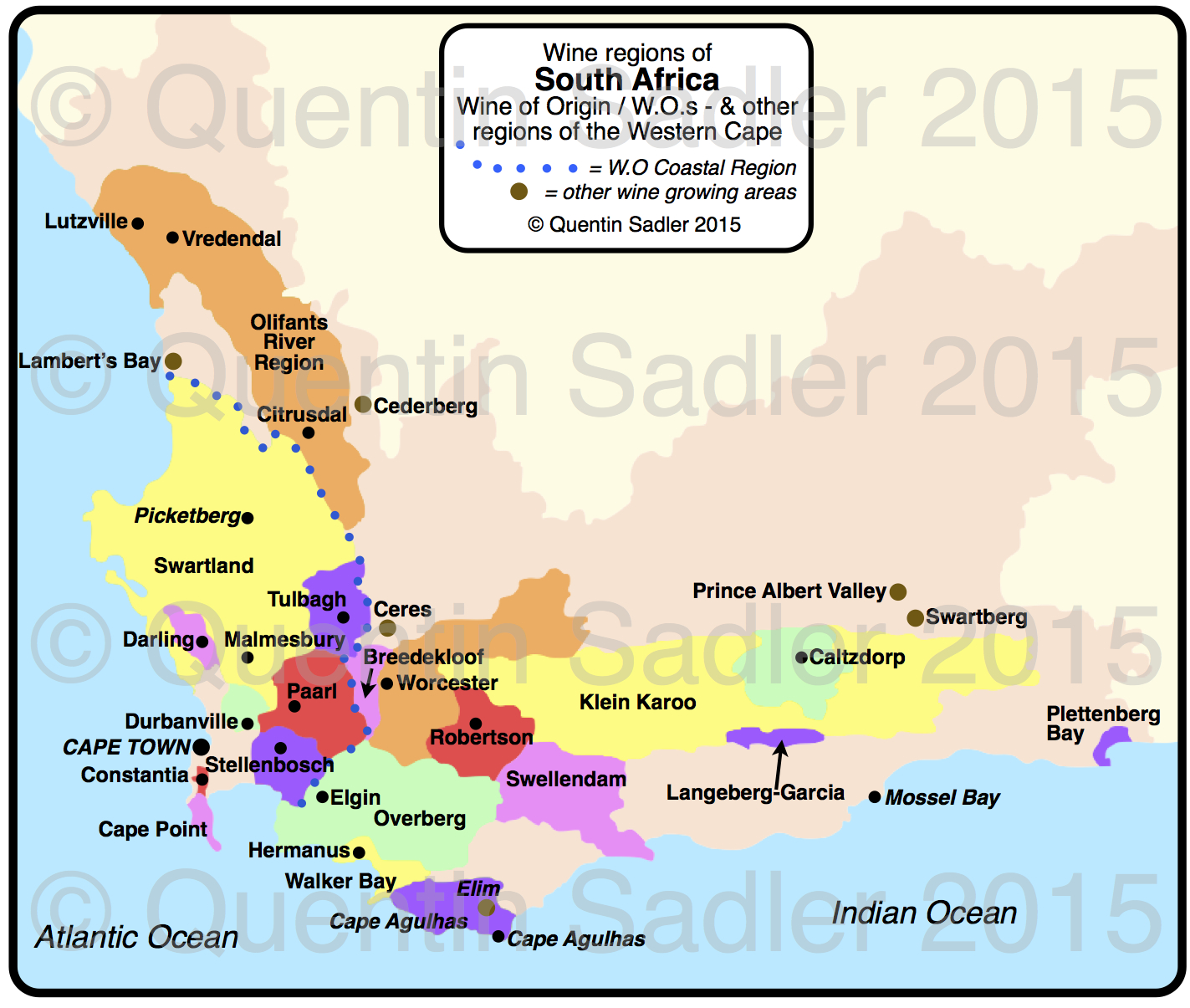
My relationship with South Africa has taken off quite dramatically in recent years. For a long time I had reservations about the quality of many of the wines coming out of the country. To me there seemed to be flashes of brilliance amidst a sea of unreliability and perhaps I unfairly focussed on the latter.

My first visit to the Cape, in 2005, reinforced that view – luckily I mainly visited the brilliant producers and was able to see for myself how ambitious and capable many of the winemakers were – something that might not have been apparent from the general supermarket offerings of South African wines in the UK at the time. What I had not expected though was to be quite so bowled over by the place. The Western Cape of South Africa is one of the most beautiful places on the planet and a wonderful part of the world to visit and I fell in love with it.

The dramatic landscape of Stellenbosch at Kleine Zalze Vineyards.

The dramatic landscape of Stellenbosch at Kleine Zalze Vineyards

So much so that when I was invited to become a judge at the excellent Michelangelo International Wine Awards I leapt at the chance. This is one of the leading South African wine competitions and is run by the wonderful Lorraine Immelman and Sue van Wyk. I am so glad that they invited me as my trips down there to taste and judge hundreds of wines – overwhelmingly, but not exclusively from South Africa – has allowed me to experience the wines of the region in a way that I would otherwise not have been able to do. It means that I have been able to really see what is going on in South Africa and to notice the amazing development over a very short period of time. It has also allowed me to make friends with many of my fellow judges from around the world and to get to know Stellenbosch very well indeed. In fact nowadays the place really does feel a little like home when I arrive at Cape Town.

Another benefit is the wonderful visits we judges get to make to a an array of wineries who sometimes mark the occasion by giving us some of their prized bottles to taste:

1937 KWV fortified Muscadelle, it was outstanding and a real privilege to taste it - especially as there were only 168 bottles ever made!

1937 KWV fortified Muscadelle – ‘Likeurwyn’ in Afrikaans, it was outstanding & a real privilege to taste it – especially as there were only 168 bottles ever made!

Charles Back spoilt us with one of Fairview's earliest vintages of Pinotage. It had a savoury fragility that showed up the Pinot Noir side of its parentage.

Charles Back spoilt us with one of Fairview’s earliest vintages of Pinotage. It was the 1976, look carefully at the bottom left of the label, & it had a savoury fragility that showed up the Pinot Noir side of its parentage.

In my visits there I have come to know and greatly admire a range of stunning wine estates that are producing wines that are at least the equal of anywhere else – Springfield and Diemersdal for instance never fail to impress me. For quite a few years now I have been a judge in the Michelangelo – with perhaps a year or 2 gap between each visit – and the progress South African wines have made in such a short time is remarkable. On my first visit the style of South African red wines was overwhelmingly not mine. It seemed to me, for quite a long time that there was over extraction, over oaking, over working – just too much of everything really, which resulted in many bitter and tarry wines – which I do not enjoy.

I have seen this fading for a while now, but my visit in 2012 saw pretty much all the wines that I tasted had emerged from this old style and were now triumphantly almost all tasting bright, fresh, fruity and balanced. The entire experience pleased me immensely and I gained an even keener love for South Africa and her wines. The trip was one of my many highlights of 2012 – but for some reason I failed to mention it in my round up of the year.

Sunset in the vineyards at Kaapzicht

Sunset in the vineyards at Kaapzicht

Sauvignon Blanc
The first thing I noticed last summer was just how good the white wines have become. Drop in anywhere around Cape Town and the winelands – the bars and restaurants are spectacular – and you can order a Sauvignon Blanc with confidence – even at the lower price points. Because it has such wide distribution over there I drank a good few bottles of Durbanville Hills Sauvignon Blanc and not only was it pretty cheap, but it was also pretty good – just the thing with the stunning seafood in Cape Town. Lourensford, Klein Constantia, Kaapzicht and Allée Bleue Sauvignon Blancs also all hit the spot with some of the wonderful calamari they serve down there too – as does Springfield‘s Life From Stone and Special Cuvée, Dornier‘s Cocoa Hill and the lovely Sauvignon from Southern Right and those from the Diemersdal Estate – including the rosé version.

It is crude to generalise, but broadly speaking I reckon that South African Sauvignons lean towards a French style – dry, mineral and crisp, but with more ripe fruit, without ever becoming quite as aromatic or upfront as classic New Zealand examples. As a style I like it very much – of course that is an oversimplification as there is huge variety, but there is enough of a truth in it to make it a reliable guide for the average drinker.

The seafood in Cape Town is amazing - strangely the calamari is always what excites me there - it really is superb

The seafood in Cape Town is amazing – strangely the calamari is always what excites me most – it’s superb there

Chenin Blanc
Good though South Africa’s Sauvignons are – and they are. The traditional white grape here is that other Loire Valley white grape – Chenin Blanc. For me these really come into their own when some richness is involved and I love drinking the tropical (ripe guava flavours), delicately honeyed and concentrated examples from Kleine Zalze, Oldenburg and Stellenrust - and Stellenrust’s Sauvignon Blanc is pretty good too by the way. These are wonderful with fish pie and rich pork or chicken dishes – even asian flavours.

Red Wines
All of these were lovely and a delight to taste in the competition or enjoy during our time off, but what really amazed me last year were the red wines. I tasted hundreds of red wines from the Cape and flight after flight showed balance, fruit and careful tannin management.

Some of the Merlots that we judged at the Michelangelo Awards were especially impressive - Lourensford‘s 2011 Winemaker’s Selection Merlot and uniWines Fairtrade Palesa Merlot 2011 were both superb, with lovely fruit and supple tannins.

I have also been very impressed by Cabernet Sauvignons from Springfield – their Whole Berry Cabernet 2008 is a seductive marvel – while the magnificent Kleine Zalze Cabernet Sauvignon Family Reserve 2008 is layered, complex and fine, as was the Oldenburg Cabernet Sauvignon 2009 that I tasted recently.

Lourensford Estate - looking south to False bay

Lourensford Estate – looking south to False Bay & Somerset West

Pinotage
All these were very good, but I personally became very excited by Pinotage – of all things. Pinotage gets a very bad press, or at best seems to divide people, much like Marmite. Well I love Marmite, but until last year I would not even remotely have considered myself to be a fan of Pinotage. I had enjoyed a few in my time – Flagstone‘s wittily named The Writer’s Block Pinotage always impresses me and the 2011 rightly won a Gold Medal at the 2012 Michelangelo – but something has usually held me back from enjoying most of the Pinotages that had come my way until recently. Well it seems that something about the wines – or me – has changed, because during my time in South Africa in 2012 I started to really enjoy Pinotage – so much so that I ordered Pinotage twice while I was last in South Africa and even requested a refill during a dinner at KWV / Laborie.

This unusual grape is South Africa’s speciality and it originated here as a cross between Pinot Noir and Cinsaut / Cinsault (historically known as Hermitage in South Africa). Like most things that appear traditional though it isn’t actually as old as you might think. The cross does go back to the 1920s, but commercially it has only really been around since the 1960s. In the past people have said that Pinotage smelled and tasted of rusty nails and bananas, which may be true, but it no longer seems to be the case in the ones that I have tasted of late. Rich fruit and supple tannins seem to be the hallmark, together with a spicy quality.

I have tasted a few different vintages now of the Diemersdal Pinotage Reserve and their 2011 vintage walked with the Pinotage Trophy (Sue van Wyk Pinotage Trophy) at the 2012 Michelangelo and it was well deserved – grab a bottle if you can find one. It was this wine more than any other that started my change of mind about the grape, but Deetlefs Estate Pinotage 2011 was very nearly as impressive and for sheer drinkability I also greatly enjoyed the spicy and juicily fruity KWV Mentors Pinotage 2010 - indeed it was this one that I requested more of during a rather fine dinner!

I have also tried and enjoyed the following Pinotages over the last few months – Wine of Origin / W.O. is the South African appellation system and guarantees the source of the grapes:

DVHP2010 Durbanville Hills Pinotage
W.O. Durbanville, South Africa
Medium-bodied, supple and juicy with very soft tannins and a gentle touch of spice. This is easy drinking, but very enjoyable and well made and would go with almost anything meaty – 86/100 points.

Durbanville Hills is a big brand, but they seem to be very reliable – their Sauvignon Blanc is very good for the price – and as they are well distributed in South Africa they are quite hard to miss, most of the umbrellas outside restaurants in Cape Town seem to be theirs.

£8.50 a bottle in the UK from SA Wines On Line.
Distributed in the US by Aveniu Brands.

southern-right-pinotage-nv2010 Southern Right Pinotage 
W.O. Hemel-en-Aarde, Hermanus, South Africa
This concentrated example is made by Anthony Hamilton-Russell, who is normally thought of as a Pinot Noir specialist, but here he shows that he can coax wonderful flavours and mouthfeel out of Pinotage, albeit with tiny amounts of Cabernet Sauvignon, Cabernet Franc, Malbec and Syrah blended in.
The palate is rich, smooth and silky with ripe damson and blackberry fruit and soft spice notes as well as cocoa from the oak ageing. This is beautifully made and very elegant – 89/100 points.

£13.50 a bottle in the UK from Waitrosedirect.com.
Distributed in the US by Vineyard Brands.

KZ Pin2009 Kleine Zalze Family Reserve Pinotage  
W.O. Coastal Region, South Africa
Wow this is an amazingly concentrated wine, deep, opaque blue-black. The nose delivers damson, espresso coffee, liquorice, dark chocolate and aromatic spices. The palate is towards full-bodied and is very supple with velvety tannins and some nice refreshing acidity too and rich dark fruit, leather, coffee and beautifully integrated vanilla and mocha oak. This is a glorious wine with an epically long finish – 92/100 points.

This is Kleine Zalze‘s top Pinotage, but their more humble examples under the Zalze label are rather good too. They also have a rather lovely restaurant at the winery by the way.

£26.99 a bottle in the UK from SA Wines On Line.

Osiris2009 Wildekrans Estate Osiris Pinotage  
W.O. Bot River, South Africa
Lifted aromas of smoky spices and chocolate together with dried red fruit and ripe black fruit. The palate offers coffee as well as damsons, blackberry and cooked strawberry fruit. Again the tannins are a very silky and the finish is long, but slightly marred by some heat from the alcohol – 91/100 points.

Wildekrans wines are in the UK from SA Wines On Line.

From my recent tastings of Pinotage I would say that the at its best the grape has a decidedly Mediterranean character showing spice and warmth – as you might expect from the Cinsault side of its ancestry. However the fruit is richer and glossier, when handled correctly – as you might imagine from the fact that it is used in a sunny place so the grapes can ripen fully. In addition the tannins seem to be very light – as indeed they are in both the parent grapes – so the good examples seem very soft and supple. And that is the key, for that delicious fruity, velvety smoothness to shine, the grapes must be really ripe and any touch of greeness will throw that balance out of kilter and spoil the pleasure I now take in a good example of Pinotage.

Much more besides
Of course it isn’t only those grapes and blends that can do well in South Africa, Altydgedacht Estate produces a stunning Gewürztraminer and possibly the best Gamay that I have ever tasted, while KWV delighted me with their fabulously drinkable, ripe and juicy Mentors Cabernet Franc, which rightly won a trophy at the 2012 Michelangelo Awards. I have also become very impressed by some of the Syrahs, especially the wonderfully supple, delicately spicy and seductive Oldenburg Estate Syrah 2009.

Michelangelo International Wine Awards
Remember that if you want to explore the wines of South Africa, but are unsure where to start, the Michelangelo International Wine Awards website lists all the winners they ever had since the competition started in 1997, take a look, it might well help you to choose some interesting wines to try. I know the effort that we put into judging them and the high standards that we adhere to, so if it won a medal or trophy at the Michelangelo it is going to be a good wine and an excellent example of its type.

Another thing to bear in mind is that South Africa is one of the best wine countries to visit as the countryside and main wine towns of Paarl, Franschhoek and Stellenbosch are all beautiful, and unlike Europe the wineries are superbly geared up for visitors with lovely restaurants and elegant tasting rooms.  What’s more everything is very compact and within an hour or 2 of Cape Town airport, which makes it an easy place to tour around.

If you do visit – and I highly recommend it – make sure you see a bit of Cape Town too, it is a delightful city and the V&A Waterfront complex is an absolute gem, stuffed with bars, shops and restaurants of very fine quality. While you are there be sure to drop in at Vaughan Johnson’s Wine Shop. Vaughan is one of the wine trade’s great characters and a delight to chat to while browsing the bottles in his lovely shop.

The man himself - Vaughan Johnson

The man himself – Vaughan Johnson

Vaughan's words of wisdom

Vaughan’s words of wisdom

So, if you have not really got into exploring South African wines yet, now is a great time to start as the quality of the wines coming out of the Cape now is very high indeed.

Santorini – A Great Wine Region

Ia_Santorini-2009-1

The stunning, rugged beauty of Santorini

I had thought that I wouldn’t write anymore about Greece and Greek wines for a while, but the sheer excitement of some wines that I have tasted from Santorini recently mean that I really have to share them with you.

Over the last month I have been giving some Greek wine tastings and as I had expected the quality of the wines won lots of sceptics over and made people look at Greek wines in a new light.

All the wines were well received and all showed very well indeed, but one region consistently proved to be the crowd pleaser. This was the white wines from the beautiful volcanic island of Santorini.

Map of Greece's Wine Regions - click for a larger view

Map of Greece’s Wine Regions – click for a larger view – see Santorini north of Crete & south of Paros

Sadly I have yet to visit the vineyards of Santorini – I hope to put that right this year though – but I have known and loved the white wines from this island for a long, long time and have almost always enjoyed them. I have found that as long as the alcohol level is not above 13.5% then these wines always deliver pleasure. Above that, and a handful are, the alcohol burn ruins the balance for me – so check the alcohol level when you first buy one.

Satellite photograph of Santorini clearly showing that it is the lip of a volcano.

Satellite photograph of Santorini clearly showing that it is the lip of a volcano.

Many of you will know Santorini I am sure, it is basically the lip of a volcano, so a settlement perched at the very top of a mountain as the rest just happens to be underwater. The place is tiny and basically solid volcanic rock which has very little organic matter and a complete absence of clay which means that Phylloxera never took hold. As a result Santorini can boast some of the most ancient vine roots in the world – up to 300 years old it seems.

Santorini's wild rocky terrain showing the low trained vines in the terraced vineyards or 'pezoules'.

Santorini’s wild rocky terrain showing the low trained vines in the terraced vineyards or ‘pezoules’.

The problems here are wind and lack of water and they solve both of these in the same way. In order to protect the vines from the extreme winds that blow across the island, they basically train the vines close to the ground and weave the stems into a basket to contain and protect the grapes as they ripen. Growing this low to the ground also maximises the effect of the morning dew on the vines.

Santorini vines woven into baskets.

Santorini vines woven into baskets on the ground – note the rocky soils.

Backbreaking work.

Backbreaking work.

Unfortunately it also means that tending these vines is backbreaking work, but like so may other extreme vineyards around the world – Mosel, Côte-Rôtie, Cinque-Terre, Etna, Ribera Sacra etc. – the results do seem to make the effort worthwhile.

Everything about grape growing on Santorini makes for naturally low yields and good concentration, so it is hardly surprising that the island has enjoyed a high reputation for its wines for thousands of years. Whatever the wines were like in antiquity though the modern wines are of excellent quality and that is thanks to these extreme natural conditions and the high quality local grapes.

Santorini is home to a handful of grape varieties and all of them are of interest, but one stands out as being especially fine, capable of being the standard-bearer for Greek wine much as Sauvignon Blanc is for New Zealand wine. That grape is the wonderful AssyrtikoAss-err-tick-OH – and frankly if you like Sauvignon Blanc (or Verdejo and Grüner Veltliner for that matter) you will like it. Who knows you might even prefer it, some of the people at my recent tastings did.

The wonderful thing about Assyrtiko is that it retains its freshness and acidity even when grown in desert conditions like those on Santorini.

The harvest

The harvest

The wines:

ASSYRTIKO2012 Santorini Assyrtiko
Santo Wines – the Santorini cooperative whose wines are marketed by Tsanatli
Santorini Protected Designation of Origin / P.D.O (like an A.O.C.)
100% Assyrtiko
I had tried the 2011 while in Greece last year and it was excellent, a real standout wine, but if anything this had the edge. The nose was stony and mineral, citrus and fresh, while the palate was crisp, bone dry and nervy. There seemed to be a purity and concentration to it that I found thrilling, the fruit was there in a lemon/lime kind of way with hints of apricots too, but it was the acidity and mineral quality that gave this its finesse and elegance and the finish was wonderously long. A great wine, how I wish I had had a bit of fish with me – 92/100 points.

As far as I am aware this is not yet available in the UK, but it really should be – check with Venus Wines.

Argyros Atlantis White bottle2011 Atlantis White
Argyros Estate, Santorini
P.G.I. Cyclades (like a Vin de Pays, but actually could be labelled as a P.D.O.Santorini)
90% Assyrtiko with 5% each of Aidani & Athiri
The other grapes make this slightly less crisp, it is softer and even slightly fleshy and textured, so it feels less pure and less mineral, but is still a gorgeous dry white wine and what it lacks in minerality and complexity compared to the pure Assyrtiko it more than makes up for in sheer drinkability. The palate gives a touch of pear that softens the citrus, while the nose has a touch of the sea – 89/100 points.

Around £10 a bottle in the UK from Marks & Spencer online.
Distributed in the US by Athenee Importers.

Santorini grapes drying in the sun

Santorini grapes drying in the sun

VINSANTO2004 Vinsanto
Santo Wines – the Santorini cooperative whose wines are marketed by Tsanatli
Santorini Protected Designation of Origin / P.D.O (like an A.O.C.)
85% Assyrtiko with 15% Aidani
Vinsanto desert wines are an old tradition on Santorini and if they are all as good as this one I can see why it caught on. Very ripe grapes are harvested and then dried in the sun for 10 days or so to further concentrate the sugars. As with all really top notch desert wine the sugar here, although high, was balanced by the sheer class of the wine and the cleansing high acidity. The flavours were astonishing with great depth, concentration and complexity. Toffee, caramel, honey nuts, nougat, apricots, orange, coffee, fig, clove show what long ageing in old oak will do, but the dominating character was freshness and liquor orange. A great, great desert wine that was superb on its own and with the baklava, but would be equally good with apple pie or strudel, and blue cheese - 93/100 points.

As far as I am aware this is not yet available in the UK, but it really should be – check with Venus Wines.

Oia on Santorini

Oia on Santorini

On this showing – and past experience – I really believe that Santorini is one of the great wine regions and Assyrtiko one of the world’s finest white wine grapes. Do try some when you can, you will not regret it, there might be nothing better with simply cooked fresh fish and seafood.

Thanks to my friends at Tsantali for most of the photographs.

A Champagne House to Thrill & Excite

I cannot help myself, I really do like Champagne. There is nothing more enjoyable than good sparkling wine in my opinion and there is no potentially finer sparkling wine than Champagne. What is more there is so much variety in Champagne, some houses produce a rich style, some a soft one, others a mellow one – surely there is something for everyone.

Rather excitingly I have recently stumbled across a small Champagne house that I am convinced deserves far greater fame.

Champagne Legras & Haas is a Champagne domaine founded as recently as 1991, but if the name rings any bells then you might well be thinking of Champagne R & L Legras which is a famous old Champagne house in the village of Chouilly in the Côte des Blancs. I have never tried their wines, but they have a very high reputation. Before he created his own estate in 1991, together with his wife Brigitte – whose maiden name was Haas, François Legras was the winemaker here as his forebears had been since the sixteenth century.

François Legras
Amongst other things it was his desire to be a true vigneron, a grower with a domaine that made him strike out on his own and today the house has 31 hectares mainly in the Grand Cru village of Chouilly, although the conditions of the region mean that they do still buy grapes in from trusted local growers – mainly for their standard Tradition Non Vintage (N.V.) Brut. Their Pinot Noir is grown mainly in the slightly warmer Aube area to the south.

Today the house is run by François’s sons Rémi and Olivier Legras and I think the wines they produce are remarkably fine.

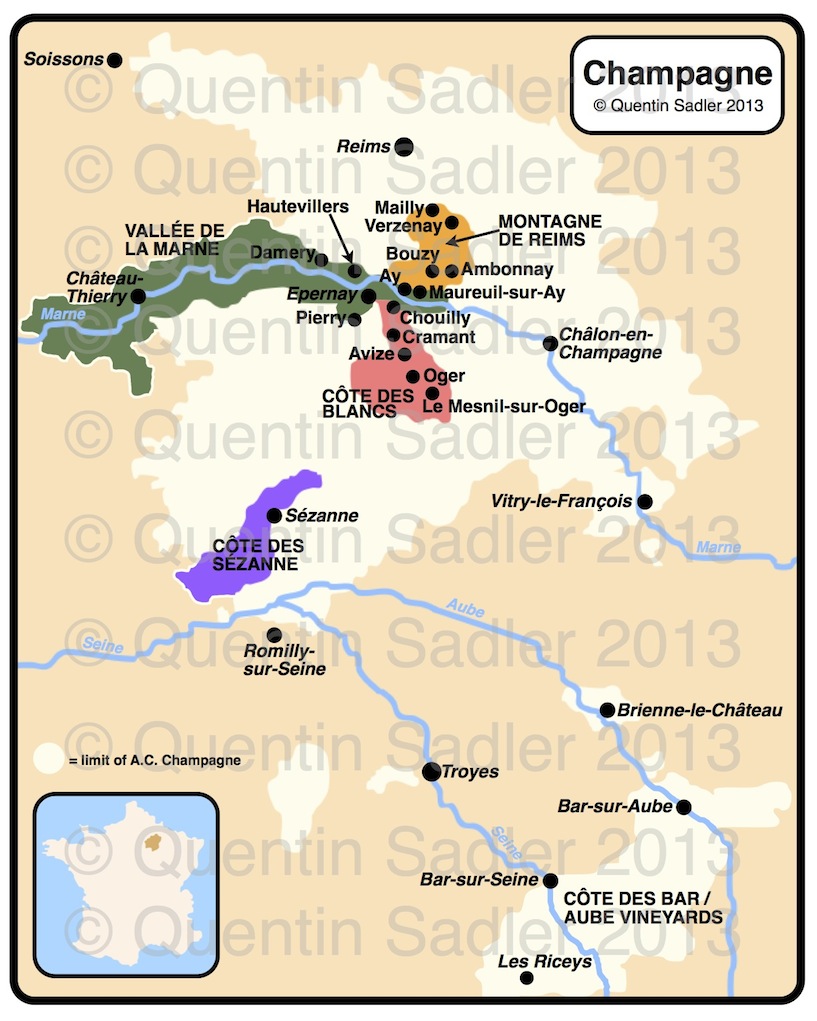
Map of Champagne – click for a larger view – non watermarked PDF versions are available by agreement

Map of Champagne – click for a larger view – non watermarked PDF versions are available by agreement

Terroir
As they are based in Chouilly in the Côte des Blancs, with its chalky fossil rich soils, they concentrate on Blanc de Blancs style wines – that is Champagnes made solely from white grapes which by and large means Chardonnay in Champagne. Contrary to popular belief Pinot Blanc - Pinot Vrai locally – can be used in the region too, but it is very rare.

Much of the soil in Chouilly is Kimmeridgian clay as in Chablis and this together with the cold climate and short growing season really does dominate the style of wines.

The wines

bouteille_brut_blanc_de_blanc_0Legras & Haas Blanc de Blancs Grand Cru Brut N.V.

The nose was lovely, fresh is the main word I would use, but there were little touches of apricot, lemon zest, pastry crumbs and stone – this really did entice and hint rather than deliver fully formed characters. It is a tease of a wine, smelling this is like watching a burlesque act.

The palate was clean and crisp with high acidity and lots of flavour of citrus fruit, green apples and minerality as well as some biscuit-like characters. The mousses was persistent and fine – and I am not one to comment on the fizz normally as it depends on too many other factors.

At only 7 grams dosage this is a very dry Brut Champagne which allows the purity and minerality to dominate. All in all this wine really excited me – 91/100 points.

FT-SW-0012-NVpLegras & Haas Blanc de Blancs Grand Cru Extra Brut N.V.

Good as that was though it was this wine that really caught my imagination. Extra Brut has a dosage of less than 5 grams per litre, so the wine is allowed to dominate the style. There is no softness here, no fat, just precision and austerity. This means that the Champagne has to be perfect first time – like a water colour.

They got it right, the wine has concentration, but is about minerality and tension. If you like Chablis you will enjoy this. It has that same nervy character and stony depth to it. The bubbles really are tiny and persistent and add some structure to the wine. Four years ageing on the lees has also added little flourishes of flakey pastry, but for me this is all about the minerality, finesse and elegant austerity – 93/100 points.

Do try these Champagnes if you can, they really are superb. I would enjoy the Brut on its own, but I think they would be particularly good with food – some fruits de mer perhaps, especially the Extra Brut.

Legras & Haas Champagnes are available in the UK from the Alaistair Nugent, Handford Wines and Private Cellar.

Legras & Haas Champagnes are available in the US from United Estates Imports and Exclusive Wine Imports

A Greek Original – Naoussa & Xinomavro

Naoussa vineyards.

Naoussa vineyards.

As some of you will know I visited Greece last year to tour some of that country’s amazing northern wine regions. I have written about some of the highlights already in my articles about Rapsani and the amazing Mount Athos, but I thought that I should tell you all about some of the wines made from Greece’s star northern black grape – Xinomavro.

My favourite road sign photographed in Macedonia in 2012.

My favourite road sign – photographed in Macedonia in 2012.

Do, please remember to click on all the links…starting with this one about my Greek wine tasting in London perhaps?

This part of Greece is where some of their truly classic wines originate and I was fortunate enough to experience a wide range of them last year and to visit many of the really exciting producers in this beautiful part of the world.

Xinomavro (pronounced K-see-NOH-mah-vroh) is the signature grape of Macedonia and makes some of Greece’s finest red wines. Agiorgitiko (pronounced Ay-yor-yitiko) from Nemea region in the Peloponnese is arguably Greece’s other really important black grape and I think they should both be a more widely grown. Indeed in my opinion both could well have a future as international grape varieties – as should Spain’s Tempranillo and Italy’s Aglianico.

Map of Greece's Wine Regions - click for a larger view

Map of Greece’s Wine Regions – click for a larger view

Xinomavro is grown across the north of Greece and is the only grape permitted in the mono-grape wine region appellations / PDOs of Goumenissa, Amynteo and most importantly Naoussa. It is Naoussa (pronounced Now-sir) that is considered to be the finest of all the regions up here and to have the greatest potential for even more future greatness. The others must not be ignored, but it is easy to see why this particular place has earned such a high reputation.

How it used to be done -

How it used to be done – the Dalamára Winery in Naoussa in the mid 1950s.

How it's done now - the Dalamára Winery in Naoussa in 2012.

How it’s done now – the Dalamára Winery in Naoussa in 2012.

Kostis Dalamaras - the 5th generation of his family to farm here.

Kostis Dalamaras – the 5th generation of his family to farm at the Dalamára Winery. He now makes beautifully supple and elegant modern wines from organically grown grapes.

As you might suspect the area has a long history of wine production, so much so that the artist Cousinery wrote in 1831: “The wine of Naousa is to Macedonia what Burgundy wine is to France. I am in a position to say that the wine of Naousa is the best in the Ottoman Empire .” In truth though I would be willing to bet that with a few exceptions we would barely recognise the wines made around here before the Second World War. Phylloxera hit this part of the world very late, so when it did arrive in the 1930s it was just one of the many problems to be coped with – world wide recession and world war followed closely by civil war must have seemed like more urgent horrors. So it was not until the tourist boom of the 1960s that the region began to be properly replanted and new wineries built – interestingly the timing is identical to the blossoming of California and Spanish wines, which just goes to show that all wine needs to develop is a long period of peace and relative prosperity.

What makes Xinomavro stand out from the crowd is its potential for elegance. The wines it makes, especially in Naoussa, can be very fine indeed. The whole place is basically a south facing slope, sheltered so the extremes of climate that other parts of Macedonia are subject to are somewhat tempered here – and it shows. What’s more the sun exposure balances the grapes variety’s natural high acidity very well indeed.

Some people like to compare Xinomavro to Pinot Noir and in terms of colour and tannin that contrast gives you a pretty good idea of what it is like. If I have to compare it to anything though, and it does make things easier if you have never tried one, then I think Nebbiolo might be a better bet. True it is less tannic, but everything else is bang on, body (not that full, whatever the books may say) and acidity, more improtantly it has red fruit characters and a similar deeply savoury, umami nature.

Delicious traditional nibbles at the Dalamára Winery in Naoussa.

Delicious traditional nibbles at the Dalamára Winery in Naoussa.

While Pinot always makes think of red cherry and raspberries, I see from my notes that Xinomavro for me is often very tomato-like in flavour and aroma. Sometimes the tomato feels fresh, other times more sun-dried or cooked and even occasionally just tomato stalk, but it is always there and makes the wines go superbly with the wonderful local cuisine.

My favourite Naoussa wines so far:

Tsantali's Naoussa vineyards.

Tsantali’s Naoussa vineyards.

tsantali naousa reserve1997 Tsantali Naousa Reserve
Tsantali
PDO Naousa
Originally from Thrace, the Tsantali company created their Naoussa estate and winery in 1970. is one of Greece’s major producers of wines – and spirits. In my opinion their quality is pretty high, whether you are just drinking one of their straightforward everyday wines or indulging in something a little more special.
40% fermented in small open fermentors and hand plunged four times daily and 60% in stainless steal tanks. 12 months in French oak, just 10% of which is new.
A little tawny and earthy red, but the colour is still quite vibrant.
The nose was smoky with prunes and concentrated cooked tomato notes.
Loads of sweet deep dried fruit and ready vanilla and caramel, some spice and raisins and prunes. Very elegant, and joyous the tannins dry the finish and the acidity just sits in the background. Superbly balanced and stunning. The finish is fresh and lively still with studs of rich sweet, smoky bacon, tomato and savoury meaty characters.
Amazingly long and intense and the finish is really smooth. A great wine that is ageing very slowly – 92/100 points.

As far as I am aware the Tsantali Naousa Reserve is not available in the UK at the present, but their tasty and excellent value non-reserve Naousa is available from Wine Rack at £7.49 a bottle.
Tsantali wines are available in the US via Fantis Foods Inc.

Yiannis Boutaris, charismatic owner of KIR-YIANNI evangelist for Greek wine and the 5th generation of his family to make wine, but the first to adopt a true estate method of production.

Stelios Boutaris, charismatic winemaker and owner of KIR-YIANNI evangelist for Greek wine and the 5th generation of his family to make wine, but the first to adopt embrace a true ‘estate’ concept.

The beautiful

The beautiful Ktima (Domaine) Kir-Yianni.

VdP_red_RAMNISTA1997 Kir-Yianni Ramnista Estate Naoussa
Ktima (Domaine) Kir-Yianni
PDO Naousa
The Boutari family have been a key part of the development of Greek wine. In many ways it was their negociant company that put Naoussa and Santorini on the wine map as quality regions and that family firm continues to this day, but Yianni Boutari, Stelios’s father branched out on his own to create this estate in 1997. When he was a negociant all the grape growers had respectfully referred to him as “Mister Yianni” or Kir-Yianni in Greek. The grapes are from selected vineyard blocks on their Yianakohori vineyard and the wine spends 12 months in a mix of 225 and 500 litre oak barrels.
Deep earthy savoury aromas mingle with black treacle and leather notes together with an underlying mix of cherry and sun-dried tomatoes.
Lovely integrated palate of wild raspberry and leather, tomato and earthy minerality. High in acid, but very soft, with smooth fine smoky tannins and tomato stem flavours. Lovely texture and tension between the freshness and richness. The finish is slightly drying, but has great balance and real finesse – 93/100 points.

Kir-Yianni wines are available in the UK through London General Trading.
Kir-Yianni wines are available in the US through different companies listed here.

P1040349

Ktima Chrisohoou.

P1040359

The delightfully hospitable Keimis & Betty Chrisohoou.

xinomavro_big2001 Chrisohoou Naoussa
Ktima Chrisohoou
PDO Naousa
The Chrisohoous are delightful people and their beautiful winery includes a fabulous museum of local culture and wine together with an amazing restaurant. Our little group were the only guests the night I was there and we were treated to course after course of stunning food – do go if you are anywhere near. The family have made wine since the 1940s, but they were basically negociants until 1978 when they started specialising in estate bottled Naoussas. They still make an enormous array of different wines, but the Naoussas are where the quality is. They are aged for 12 months in French oak barrels.
Earthy red with a kiss of orange pink in the rim too.
Delightfully vibrant nose, with red cherry and leaf mulch forest floor sort of aromas.
Plenty of soft fruit, red raspberry and deep cherry on the palate. Lovely almost creamy texture with some spice and oak characters like toffee and coffee and the acidity provides a balancing touch of freshness.
The most Pinot Noir like Xinomavro I tasted on the trip, beautifully balanced and ageing very very slowly – 92/100 points.

in his vineyard.

Kostis Dalamaras in his vineyard.

Kostis Dalamaras amongst his vines.

Kostis Dalamaras amongst his vines.

Feeding time at Dalamara - they are inseparable pals!

Feeding time at Dalamara – they really are inseparable pals!

11592008 Paliokalias Naoussa
Dalamara Winery
PDO Naousa
Kostis Dalamaras farms his vineyards organically and seems to really love this land that his family have tended since 1840. The place is small, homely and teeming with cats. It reeks of tradition, but there is nothing old-fashioned about Kostis’s wines, they really are exquisite and very Burgundian in feel. His Paliokalias is a lieu-dit and is a remarkable wine made from 80 years old vines and is aged for 12 months in French oak barrels.
The nose was very Burgundy-like here, earthy and savoury, while the palate was a beautifully poised and elegant wine with gorgeous balance between the fruit and gently spicy oak. Lots of red berries and plums gave way to sun-dried tomatoes and then a twist of tapenade for good measure – 91/100 points.

Naoussa vineyards.

Naoussa vineyards.

Young Vines2011 Thymiopoulos Young Vine Naoussa
Domaine Thymiopoulos
PDO Naousa
31 year old Apostolos Thymiopoulos is great winemaker and like Kostis Dalamaras is a rising star of Naoussa. He doesn’t make much, so his top wines are hard to track down – in the UK anyway. Luckily the same problem does not exist for this wine made from the younger vines on the estate and vinified using only the wild yeast and 30% is aged for 3 months in a mixture of 225 litre, 300 litre & 500 litre oak barrels – both of these give more complexity.
This could well be the best wine to try first, if you have never tasted a Naoussa. It is gloriously bright and seductive, bursting with cherry and raspberry fruit with fresh acidity and attractively chalky light tannins. Fresh tomato and tomato stalk characters provide the savoury notes to balance the sweetness of the red fruit. A lovely user-friendly wine that goes with all manner of lighter dishes and tastes good lightly chilled too, if you like good Gamay, Pinot Noir, Nebbiolo or Barbera this is the wine for you – 89/100 points, it scores especially high marks for value.

Available in the UK from The Wine Society for £10.50 a bottle.
Available in the US from K&L Wines for $14 a bottle.

But wait, there’s more: Alpha Estate – Amynteo
So, if wines in the Nebbiolo, Pinot Noir mould are your thing then you have a wonderful new region to explore in Naoussa. Excitingly though there is even more for you to discover. It isn’t in Naoussa, but no article about Xinomavro would be complete without a mention of the Alpha Estate.

Angelos Latridis the charismatic and winemaker and owner of the Alpha Estate.

Angelos Latridis the evangelistic winemaker and owner of the Alpha Estate.

400329_353038728058000_2080408263_n

The Alpha Estate.

P1040197

Alpha Estate vineyards, note the sandy soil.

The Alpha Estate was the brainchild of Angelos Latrides and Makis Mavridis who saw great potential in the underused Amynteo region. It is higher and cooler than Naoussa with more rain in the winter, but enjoys hot summers, which are tempered by the nearby lakes and excellent sun exposure. In addition the sandy soil is protection against phylloxera and because of that there are pockets of very old vines in the region.

Old Xinomavro vine in sandy soil - more than 80 years old.

Old Xinomavro vine – more than 80 years old – in sandy soil at the Alpha Estate.

Alpha Estate is an exciting wine producer, it has the feeling of being cutting edge and experimental and as a consequence they grow lots of different grape varieties, including Syrah, Merlot, Negro Amaro and Barbera, but the signature grape for them is ungrafted Xinomavro and they make several different examples, all of which are very, very good, even the more affordable Hedgehog label. It seemed to me that the hallmark was freshness and terrific integration in their wines and it was interesting that they use oak with almost no toast at all.

59113-xynomavro-reserve-old-vines-400x7002006 Alpha Estate Old Vine Xinomavro
Alpha Estate
PDO Amynteo
Medium to deep black cherry colour with deep black cherry aromas together with freshly cooked tomato aromas, dried cherry, cherry stone, herbs and molasses. The palate has a lovely succulent texture with fantastic freshness and gentle opulence. The fruit is the thing right now with bright tomato and cherry and cooked tomato dominating the underlying dryness and austerity. Real freshness, elegance and finesse, but very very drinkable too and no sign of leather or ageing yet – 92/100 points.

Alpha Estate wines are available in the UK through Novum Wines.
Alpha Estate wines are available in the US through Diamond Importers Inc.

I do hope all this has whetted your appetite to go and try some Xinomavro from Naoussa or Amynteo. There is a wonderful array of quality Greek wines just waiting for intrepid wine drinkers to discover. What appeals to me is that they are classic European wines, but with new and different flavour profiles, so both familiar in many ways, but also exciting and different.

Go on, try some and let let us all know what you made of them.

Burgundy – it just seems complicated

Santenay

Santenay Clos des Cornières

Recently I was invited over to Burgundy as the guest of a campaign called Discover the Origin whose job is to promote traditional European products that have a clearly defined place of origin – Burgundy is a classic example. It was a wonderful trip and gave me a realinsight into this incredible wine region.

P1040726

Beaune, Burgundy’s main town, is a delightful place to explore.

All those medieval building still need looking after, so the old skills still exist here

All those medieval building still need looking after, so the old skills still exist here.

Many of my students find the sheer variety of Burgundy wines intimidating and the array of labels bewildering, which is presumably why some of the easier to understand examples are the best sellers.

I agree that at first glance Burgundy can look complicated, but actually it isn’t hard once you strip it down to basics and learn to trust Burgundy rather than fight it.

Of course that does depend on how much you really want to get to grips with the place and its wines. Becoming a world authority on Burgundy will be fiendishly difficult, but the good thing is that no one really needs to understand everything about it. Most of us just need enough information to enable us to enjoy the stuff without worrying too much about the potential pitfalls.

Here is my best advice to those of you who would like to get to grips with Burgundy, but find the complications off-putting – oh and if you do know about Burgundy, look away now, this is for the many interested, but nervous wannabe-Burgundy drinkers I meet.

Please remember to click on all the links.

The basic thing to get to grips with, perhaps more than any other wine region, is the geography. The wines are not big, rich and fruity, but dry and savoury because they come from somewhere cold with short summers. The fundamental dimensions and weight of most of the wines are similar as you would expect given that almost all the white wines are made from Chardonnay and the reds from Pinot Noir – both these grapes originate here. The winemaking is pretty similar too and the grapes are grown over a relatively small area, so the climate does not change much and variations are subtle. Every time I taste a lot of Burgundy I find myself writing many of the same words. I know the wines are different, but those differences are so subtle that they are very hard to sum up in a simple way.

Tradition

Frédéric Drouhin, urbane and charming director of Maison Joseph Drouhin which was started by his grandfather.

Frédéric Drouhin, urbane and charming director of Maison Joseph Drouhin which was started by his grandfather. The visit here was delightful and the wines had all the elegance you would expect.

P1040855

En garde – the delightful Alain Hasard with his pigeage plunger. Note the small scale of the vats at his wonderful little domaine Les Champs de l’Abbaye. All his viticulture is organic and indeed biodynamic inspired – I liked him and his wines.

Jean-François Chapelle of Domaine Chapelle in Santenay

Jean-François Chapelle of Domaine Chapelle in Santenay – his wines are superb too.

Marion Javiller of Domaine Patrick Javiller. They made 2 of my favourite wines from the trip and rather wonderfully I could afford them too -

Marion Javiller of Domaine Patrick Javiller. They made 2 of my favourite wines from the trip and rather wonderfully I could (almost) afford them too – 2010 Bourgogne Blanc Cuveé Oligocène and their wonderfully silky 2010 Savigny-les-Beaune 1er Cru Les Serpentières.

The tool rack at Domaine Joseph Voillot. I loved their Volnay wines, especially the sumptuous, yet mineral 2010 Volnay 1er Cru Les Caillerets.

The tool rack at Domaine Joseph Voillot, note the Tastevin. I loved their Volnay wines, especially the sumptuous, yet mineral 2010 Volnay 1er Cru Les Caillerets.

Patrice Olliver of Domaine Fougeray de Beauclair in Marsannay. Amongst many other lovely wines he makes an intriguing and rather good white from 100% Pinot Beurot which is the local name for Pinot Blanc.

Patrice Olliver of Domaine Fougeray de Beauclair in Marsannay. Amongst many other lovely wines he makes an intriguing and rather good white Marsannay from 100% Pinot Beurot which is the local name for Pinot Blanc.

Remember that Burgundy is a deeply traditional wine region where most of the producers are really just small family owned farms. This is not a place of big brands and industrial sized wineries and this traditional outlook shows in the wines, probably more than any other place in the world today. These wines are made by people who passionately believe this is the best place on earth to make wines and that the wines of their region are the best in the world.

As a consequence the idea of a wine being bright, bold and very fruity is almost an impossible concept for a traditional Burgundian to understand. Therefore expect elegance not weight, delicacy not power and the wines to be fundamentally savoury rather than sweetly fruity. As a consequence Burgundy wines really are best suited to being drunk with food. Most Burgundians would never think to drink a glass of wine on its own, that is what a Kir or Kir Royale is for. Wine, Burgundy wine anyway, accompanies food.

Vineyards

Santenay again

Santenay again

Marsannay

Marsannay

Something else that is a little different here. Very few vineyards in Burgundy have just one owner. Usually a single vineyard site is owned by several different growers and producers all making their own version of the wine. That is why a wine that appears to come from a specific vineyard often has many different labels. That is why wines that perhaps ought to be the same can sometimes taste more varied. If there is a single owner of a specific vineyard it will usually say ‘monopole‘ on the label to show it is that grower’s monopoly.

Geography
To enjoy and appreciate Burgundy you need to either be vaguely aware of the geography or at least choose to accept it or find it interesting rather than intimidating. All the important information on the labels is geographical, it’s all just place names, the region, district names, village names or vineyard names. Personally I find it useful to embrace the unknown on a wine label – if you have never heard of the place or grape on a label, try it. What is the worst that can happen?

Understanding the Labels

ImageHandler-1.ashx

A good quality Bourgogne from a famous producer – this one informs us that it made from Chardonnay, most Burgundy labels do not mention grape variety.


The more basic wines from Burgundy are labelled as Bourgogne, which is French for Burgundy and is the catch all appellation for the whole region. Bourgogne is an appellation d’origine contrôlée (AOC or AC), which is a system of guaranteeing provenance to the consumer. Similar controls are found throughout the EU - and beyond - to regulate traditional products like ham, cheese and spirits, but wine is the most famous.

Some seemingly humble Bourgogne wines are very good and will give you an idea of the fundamental style of the region. These wines tend to be the more affordable ones – but that is not always the case and knowing the exceptions is where your hard won experience will eventually count.

Districts

ImageHandler.ashx

22144

The district names of Burgundy appear on many labels as a more specific place of origin than Bourgogne. These show that the wines comes from a distinct part of the region, rather than  the region as a whole. Chablis and Mâcon are districts, as are Bourgogne followed by the name of an area, such as Bourgogne Côte ChalonnaiseBourgogne Côtes-du-CouchoisBourgogne Côtesd’Auxerre or Bourgogne Hautes-Côtes-de-Beaune. No one knows them all, well I don’t anyway, but once you understand the principle this sort of labelling is quite straightforward.

After a while you will start to notice the subtle differences in how these various wines taste. For instance the wines of Mâcon are clearly softer, fruitier and taste as though they come from somewhere warmer than the cold northerly slopes of Chablis. While Chablis wines are more mineral, taut and crisp than a Mâcon – the cool climate shows in the wine.

Villages

vill

This white wine comes from the village of Puligny-Montrachet

Quality in Burgundy is supposed to be all about the vineyard site – remember those subtle variations – so in the quest for quality it is always good to know where your grapes were grown. Therefore the benchmark for Burgundy is the wines that have the name of a village on their label. The grapes that the wine is made from were grown in vineyards that surround that particular village, so we know where the wine originates. Meursault, Beaune, Nuits-St-Georges, Puligny-Montrachet, Mercurey and Givry are examples of these village wines.

Premier Cru & Grand Cru
You have to remember that grapes have been grown and wine has been made in Burgundy for hundreds and hundreds of years. Over that time certain places have come to be regarded as having the inherent ability to produce better wine than others. This accounts for why some villages are so famous.

Some specific vineyard sites within the villages can also be thought of as producing better wines than others, or at least to be capable of producing better wines. To celebrate and affirm the potential quality of these vineyard sites many have been awarded Premier Cru /1er Cru status and if the fruit all comes from a single 1er Cru vineyard the name of that site will appear on the label together with the village name.

1er

This white also comes from Puligny-Montrachet, but more specifically the 1er Cru site called Les Folatières.

The very pinnacle of Burgundy production though is the Grand Cru vineyard sites. These are places that are thought to be capable of producing the very finest and most concentrated Burgundy wines of all – there are not many of them and they do not produce much wine at all, so are often eye-wateringly expensive.

Grand

The Montrachet vineyard is shared between the villages of Puligny and Chassagne and has been added to the name of both villages.

So many UK wine drinkers brought up on wines labelled by grape variety seem to want to rant, rail and kick against the traditional French way of doing things. It makes life much easier to just accept it, pay attention to the information on the label that is useful to you and ignore the rest. I always warn my students to never go looking for consistency or logic in French wine regulations as they often mean subtly different things from region to region even when they use the same words.

On my trip I visited a wide range of producers, from big names with grand cellars and lots of employees to tiny, hands on vigneron who scratch a living from a tiny patch of vines. All were passionate about Burgundy though. They all loved their land and thought the site mattered. None of them in their hearts believed they were producing Pinot Noir or Chardonnay wines. They were merely using those grapes to express the character of the land they farmed – they were bottling Meursault, Volnay, Savigny-les-Beaune, Mercurey or Montagny. Their wines were capturing and celebrating the subtle differences and variations that make each of these wines unique.

It is precisely these differences that make Burgundy so interesting and worthwhile to the wine enthusiast and over time the very real, but subtle variations between wines from the Côte de Nuits, Côte de Beaune and the Côte Chalonnaise become apparent.

The beautiful cellars of Domaine Heresztyn in Gevrey-Chambertin

The beautiful cellars of Domaine Heresztyn who make lovely wines in Gevrey-Chambertin.

What makes the differences is best shown by using the Côte d’Or as my illustration. This part of Burgundy is the most celebrated and contains most of the really famous wine villages of the region. Of the truly renowned Burgundy areas and villages, only Pouilly-Fuissé and Chablis are not found in the Côte d’Or.

Map of Burgundy – click for a larger view – non watermarked PDF versions are available by agreement

Map of Burgundy – click for a larger view – non watermarked PDF versions are available by agreement

At first glance the Côte d’Or, made up of the Côte de Beaune and the Côte de Nuits, would appear to be so small that the wines it makes must surely all be pretty similar – after all it is sometimes less than half a kilometre wide. However, this is the place that really demonstrates the French concept of ‘terroir‘. The soils and conditions really matter here and make for the differences between the wines, although nuances might be a better word than differences as they are slight. The limestone ridge or escarpment that is the Côte d’Or consists of layers of different limestones, some more porous than others, as well as marls made up of clay, sand and gravel.

That makes sit sound as though it is all uniform, but it really isn’t. The limestones have weathered and decomposed at different speeds and are pierced by small rivers and dry valleys making for great variation as to which limestones dominate different parts. The topsoil also varies, as some are flinty and some a more chalky scree and the collapsing of the limestone ridge leaves different types and depths of topsoil.

Another variable is aspect, there are fissures, gaps, ravines and valleys in the limestone which change the direction a little, so some vineyards face more directly south than others – these will generally produce bigger wines as the grapes get more sun and so have more sugar which produces more alcohol and extract in the finished wine.

Luckily for us we don’t have to learn what the soil composition is of each and every village, let alone vineyard site, which is good because there is a great deal of overlap and variation making it very difficult to generalise to any useful degree. No, we only have to try the wines and see which ones we particularly enjoy.

So the next time you fancy some good charcuterie, try a red Burgundy with it, or it would be perfect with Boeuf Bourguignon or Coq au Vin too, those wonderful classic dishes of the region. White Burgundy really comes into its own with soft, squidgy cheeses or a simply cooked piece of fish.

If you really want to open your eyes to Burgundy though I would really recommend visiting the place for yourself, there is so much to see and enjoy.

Reluctantly leaving Beaune behind.

Reluctantly leaving Beaune behind.

Great British Food – it is great

It was only in 2005 that French President Jacques Chirac memorably damned British food with those astonishingly ill-chosen words, ”you can’t trust people who cook like that“. So, there was no doubting his view, which was once that of the world at large – even the British themselves. When I was growing up in the 1960s and ’70s, very few people seemed interested in good food in Britain at all and looking back it seems the menus, both at home and out, were very limited and dull. I well remember watching items about the French lifestyle on Blue Peter and hearing that old cliché; “the British eat to live, while the French live to eat.”

In those days there were still the last vestiges of the old British view that things should be plainly cooked, that anything fancy was suspect and that being interested in food was not quite right and really a funny foreign idea altogether. Certainly the British of the day were unlikely to indulge in earnest conversation about food, the way Spaniards will about Jamón, the French about cheese or the Italians the relative merits of oils and vinegars.

So, if Chirac has made that statement in 1975 I would have probably agreed with him, but all that really has changed now. Enjoyment of food now seems to be an integral part of British life and food is no longer regarded as just fuel. I love eating out anywhere I go in Europe, but in reality the variety and quality of food available in Britain now is as good as anywhere – different, but certainly as good. I don’t just mean fine dining either, this country is full of exciting affordable places that turn out delicious food at all price levels and from an enormous array of ethnic backgrounds.

However food isn’t only about eating out, restaurants and fine-dining. It’s also about the ingredients and this is where it seems to me there has been a more profound change. Everywhere I go there seem to be local producers of fabulously tasty things, wonderful cheese shops and delis and nowadays we all take it for granted – my mother would have loved it. She died in 1978 when just buying spaghetti involved a special journey to an Italian shop in town and we had to bring our garlics and olive oil back from Spain.

One of these exciting food producers really appeals to – The Artisan Smokehouse – me and I have been fortunate enough to try quite a few of their products. Frankly if you are at one of the events where they show their wares – I regularly bump into them at the excellent Three Wine Men tastings – then you just cannot miss them as the smell is wonderfully enticing. I love the smell of smoked food and so it always beckons me over.

However, much as I like the aromas and flavours of smoked food, Tim Matthews has a palpable passion for it – which is why he and his wife Gillian started The Artisan Smokehouse some seven years ago. Talking to him he really does come across as a sort of Heston Blumenthal of smoking. There doesn’t seem to be anything he won’t have a go at smoking and precious few things that he hasn’t actually smoked – even maple syrup apparently.

Indeed Maple seems quite a thing with Tim, he does all his smoking over natural maple wood chippings and I know from personal experience that maple wood has a wonderful smell of sugary maple syrup.

Tim & Gillian

Tim and Gill Matthews

“It started off as something fun to do, but we now supply delis county-wide and see ourselves as part of the growing Suffolk food mafia!” said Tim.

In truth the smoking process is only something that I have a superficial understanding of, but whenever I speak to Tim he really draws me in. He is passionate about his craft and food in general, flavour seems very important to him and this enthusiasm is infectious.

His passion shows in the foods he produces and in the raw materials he smokes. The flavours he achieves strike me as being very delicate. Sometimes with smoked food that is all you can taste – the smoke. With Tim’s products the smoking seems subtle and integral to the other flavours. The texture and the flavour of the raw material are as important as the smokiness.

Truthfully though the thing that originally got me interested in his wares seems pretty unsubtle, it was smoked garlic. He smokes whole heads of British garlic and the aromas are just so enticing. Wrapped in foil and roasted, the soft flesh of the garlic is unctuous and delicious with a rich smoky note and pungent character – trust me it is fabulous on toast!

I am not the greatest fan of smoked salmon, but their Freedom Food Smoked Scottish Salmon was a revelation with a deep flavour that seemed to have a fruity quality to it. Even better, to my mind, was the Freedom Food Hot Smoked Scottish Salmon Fillet, the flakes of fish were firm yet succulent with a fragrant flavour reminiscent of Chinese tea. The hot smoking actually cooks the fish and so the texture is unlike most smoked salmon and like a piece of cooked fish, but with that delicious fragrant smoky quality.

Just before trying the smoked fish I wondered what wine to have with it. Something about the aromas of the food made me think of  that Grüner Veltliner would be good, so went in search of a bottle. However I found a lone bottle of something else that got me thinking and changed my mind. I am glad I did as the combination was perfect:

Dr%20F%202009%20Rkatsiteli2008 Dr Frank Rkatsiteli
Dr Konstantin Frank’s Vinifera Wine Cellars
Hammondsport
New York Finger Lakes A.V.A.
New York State

An unusual grape, Rkatsiteli is from Georgia, but was widely used throughout the USSR, including Ukraine as well as more widely in Eastern Europe. It has an aromatic, floral and spicy kind of character, so will appeal to fans of Grüner Veltliner and dry Furmint.

This was great with both the smoked salmons. Just a lingering succulent softness showed this was a mature white and it balanced the acidity, which was still enough to be a perfect foil to the smoky flavours and fatty feel of the smoked salmon. The aromatic and fragrant nature of the wine was a great match for the fish too, as was the delicate spice character. A terrific dry white wine and a great combination – 90/100 points.

The 2010 vintage is available in the US from the winery at $15 a bottle.
Dr Frank’s wines are available in the UK from Wine Equals Friends.

Artisan Smokehouse hamper

A hamper from The Artisan Smokehouse

The meats are equally good by the way, the Smoked British Fillet Beef is so tender and fresh tasting with the flavour of the meat and that of the smoke sitting perfectly together. Tim’s Smoked Free Range Duck Breast is delicious too, despite being smoked you can taste the duck as well as the fragrant smoky flavour – it would be great in a gourmet salad.

I was also delighted to be able to try his speciality Violino di Capra – marinated, cured and smoked goat leg – which was stunningly delicious, fragrant, delicately meaty and fragrantly smoky.

The smoked meats would be wonderful with any red that wasn’t too strong by the way, earthy, umami flavours help too. Wines with the weight of a rich Beaujolais or fruity Pinot Noir are perfect. A smooth Syrah or a Barolo could be good too, like Spar’s excellent value earthy and meaty 2007 Valle Vento Barolo.

So, as you can see from my reaction to a small cross section of the range from The Artisan Smokehouse, what they make is delicious and terrific quality. It strikes me that one of their hampers would make a wonderful present for the foodie in your life.

The Artisan Smokehouse
Tim and Gill Matthews
Telephone: 01394 270609
Email: info@artisansmokehouse.co.uk

http://www.artisansmokehouse.co.uk

ImageGen.ashx

The Rusty Pig’s cooking chorizo

The Rusty Pig 
As if all this smoked gorgeousness wasn’t enough, I was recently tutoring a wine tasting and Robin Rea was giving tastes of the charcuterie that he makes down in Ottery St Mary in Devon. Robin is an experienced chef and still cooks at River Cottage HQ, but he has a passion for curing and air drying charcuterie. I really think what he makes is as good as anything I have had from France, Spain or Italy – the chilli salami was amazing, intensely hot and sweetly tasty by turn, like a gourmet’s Russian Roulette! It was all, as Robin says, “pigging delicious.”

What’s more, it isn’t only a shop where you buy amazing sausages and bacon, you also can eat there.

Robin Rea

Robin in full swing

Rusty Pig
Robin Rea
Telephone: 01404 815580
Email: robin@rustypig.co.uk

http://www.rustypig.co.uk/gb.aspx

It would seem that Chirac was completely wrong, we have thrown out that old view of British food and are now as keen as anyone else to eat great food, cook great food and to produce great food.